

Middle back pain is one of the most frequently reported and yet most frequently misunderstood forms of musculoskeletal discomfort. While lower back pain dominates clinical conversations, pain in the thoracic spine (the middle section of the back, between the base of the neck and the bottom of the ribcage) can be equally debilitating, disrupting posture, sleep, work, and daily mobility.In many cases, the underlying cause of persistent middle back pain is not a muscle problem at all it is facet joint inflammation. Yet because this condition is frequently overlooked or misdiagnosed, patients can spend months or even years without receiving the targeted treatment that could resolve their pain.
In this guide, Mr Amit our consultant neurosurgeon at Renew Skin & Health Clinic in Leamington Spa explains what causes thoracic facet pain, how it is diagnosed, and how facet joint injections can provide effective, lasting relief.
What Is the Thoracic Spine and Why Does It Hurt?
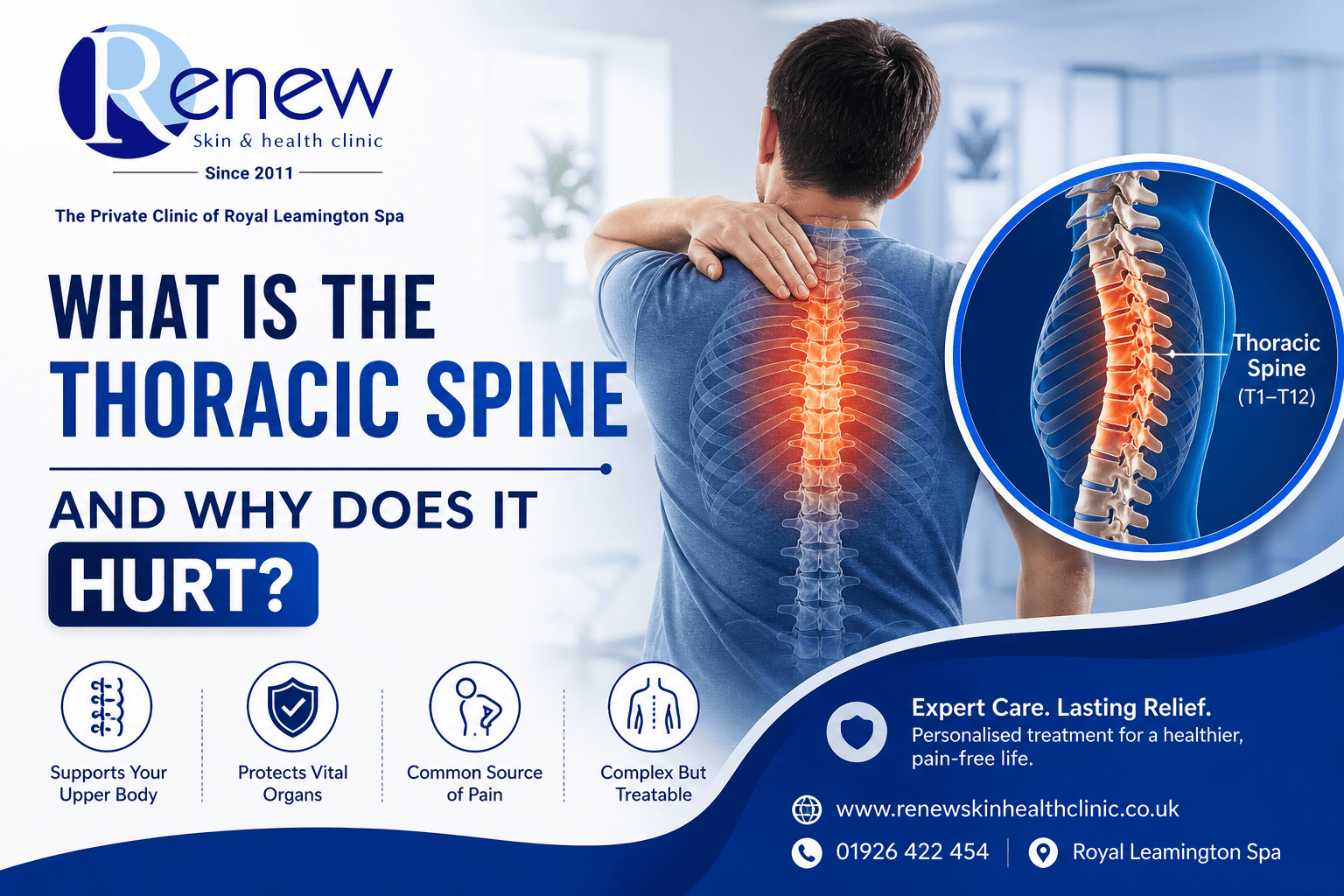
The thoracic spine consists of 12 vertebrae (T1–T12) that run from the base of the neck to the lower back. Unlike the cervical (neck) or lumbar (lower back) regions, the thoracic spine is relatively stable because of its connection to the ribcage. However, this stability does not make it immune to pain and when the small joints that connect the vertebrae become irritated or inflamed, the resulting facet pain can be persistent, difficult to locate precisely, and easily confused with other conditions.
Facet joints also known as zygapophysial joints are pairs of small joints located at the back of the spine between each vertebra. They guide and restrict spinal movement, providing stability while allowing controlled rotation and extension. When these joints degenerate or become inflamed, the surrounding nerves are affected, producing the characteristic aching, stiffness, and movement related pain associated with thoracic facet joint inflammation.
What Causes Facet Joint Inflammation in the Middle Back?
There are several recognised causes of facet joint inflammation in the thoracic spine. In many patients, more than one contributing factor is present:
1. Age Related Degeneration
As we age, the cartilage cushioning the facet joints gradually wears down a process known as spondylosis. This causes the joint surfaces to rub against one another, leading to inflammation, bone spur formation, and progressive pain. Age related degeneration is the most common underlying cause of chronic facet joint pain in adults over 40.
2. Poor Posture and Prolonged Desk Work
Extended periods of sitting particularly in a forward leaning position at a desk or screen place abnormal compressive forces on the thoracic facet joints. Over time, this sustained load causes micro irritation that can develop into persistent inflammation. This is increasingly common in people who work from home or in office environments, and it is one of the most preventable causes of middle back pain.
3. Previous Spinal Injury or Trauma
A previous injury to the thoracic spine whether from a road traffic accident, a fall, a sports injury, or a workplace incident can alter the mechanics of the spine and place abnormal stress on the facet joints. In some patients, facet joint pain may not develop until months or years after the original injury, making the connection difficult to identify without specialist assessment.
4. Repetitive Strain and Occupational Overuse
Repetitive movements involving twisting, bending, or lifting common in trades, healthcare, retail, and manual labour can cause cumulative wear and irritation of the facet joints. Unlike acute injuries, repetitive strain damage develops gradually and may be dismissed as general back soreness before the underlying facet joint involvement is identified.
5. Arthritis of the Facet Joints
Osteoarthritis the most common form of arthritis can affect the facet joints directly, causing cartilage loss, joint space narrowing, and bone on bone friction. Inflammatory arthritis conditions, such as ankylosing spondylitis or psoriatic arthritis, may also involve the thoracic facet joints and typically present with additional systemic symptoms that require specialist evaluation.
This pattern is a key reason why thoracic facet issues are often misdiagnosed as intercostal neuralgia, costochondritis, or even cardiac related pain.
At Renew Skin & Health Clinic, Mr Amit Amit carries out a thorough clinical assessment, including a detailed history and targeted examination, before recommending the most appropriate course of treatment.
How Is Thoracic Facet Joint Pain Diagnosed?
Diagnosing thoracic facet pain requires a combination of clinical assessment, patient history, and in many cases a diagnostic injection procedure. Standard imaging, including X-ray and MRI, may reveal facet joint changes, but imaging findings alone do not always correlate with the level of pain a patient is experiencing.
The most reliable way to confirm the facet joint as the source of pain is through a diagnostic facet joint injection. In this procedure, a small volume of local anaesthetic is injected precisely into or near the target facet joint under ultrasound guidance. If the patient experiences a significant and measurable reduction in pain following the injection, the diagnosis is confirmed.
A medial branch nerve block in which anaesthetic is injected near the nerves that supply the facet joint, rather than into the joint itself may also be used as a diagnostic tool, particularly when radiofrequency ablation is being considered as a next line treatment.
What Are Facet Joint Injections and How Do They Work?
Facet joint injections are a minimally invasive, evidence based treatment for facet pain treatment that involves delivering a precise combination of anti-inflammatory medication directly into or around the affected thoracic facet joints. The injection typically contains a corticosteroid (to reduce inflammation) and a local anaesthetic (to provide immediate pain relief). Together, these agents work to:
- Reduce the inflammatory process within and around the facet joint
- Block the pain signals transmitted from the joint to the brain via the medial branch nerves
- Improve spinal mobility and posture by removing the muscular guarding response triggered by pain
- Confirm the facet joint as the definitive pain source, guiding future treatment decisions
Types of Facet Joint Injections Available at Renew Skin & Health Clinic
Mr Amit offers three main types of facet joint injections at our Leamington Spa clinic, each suited to different clinical presentations:
| Injection Type | What It Involves | Best Suited For |
|---|---|---|
| Intra articular facet injection | Medication is delivered directly into the facet joint cavity to reduce inflammation and relieve pain. | Therapeutic pain relief in patients with confirmed facet joint arthritis or inflammation. |
| Medial branch nerve block | Anaesthetic is injected near the medial branch nerves that supply the facet joints. | Diagnostic confirmation of facet related pain and as a preparatory step before radiofrequency ablation. |
| Thoracic facet injection (ultrasound guided) | Precisely guided injection into the thoracic facet joint using real time ultrasound imaging for accuracy and safety. | Middle back pain caused by thoracic spine facet joint involvement. |
Key takeaway: Different types of facet joint injections serve both diagnostic and therapeutic purposes. The most appropriate option depends on the underlying cause of pain and clinical assessment by a specialist.

Meet Mr Amit Amit
Consultant Neurosurgeon | GMC No. 6047850
- Mr Amit Amit is a GMC registered consultant neurosurgeon specialising in spinal surgery, pain management, and headache intervention.
- He trained at Royal Free Hospital (London), Frenchay Hospital (Bristol), Royal Victoria Hospital (Belfast), and completed an advanced fellowship in Ohio, USA.
- He is a member of BASS, Eurospine, and the Society of British Neurological Surgeons.
The Facet Injection Procedure — What to Expect
At Renew Skin & Health Clinic, the facet injection procedure is performed as a same day, outpatient treatment. There is no hospital admission and no general anaesthetic. The entire process, from arrival to discharge, is typically completed within two hours.
- A thorough clinical assessment is carried out by Mr Amit, including a review of your medical history, imaging, and symptom pattern.
- You are positioned comfortably for the procedure. The skin over the treatment area is cleaned and a local anaesthetic is applied to minimise discomfort.
- Using real time ultrasound imaging, Mr Amit guides a thin needle with precision to the target thoracic facet joint.
- The anti inflammatory medication typically a corticosteroid and local anaesthetic combination is injected carefully and accurately into or near the joint.
- You rest briefly in our clinic for observation before being discharged. Most patients are able to travel home on the same day.
Most patients are able to resume their normal daily activities within 24 hours of the procedure. Mr Amit will provide personalised aftercare instructions at the time of treatment.
What Results Can You Expect From Facet Joint Injections?
The results of facet joint injections vary between patients depending on the severity of joint involvement, the type of injection used, and how long the condition has been present. Based on Mr Amit’s clinical experience and the wider published evidence, patients can typically expect the following:
- Mild soreness at the injection site for 24–48 hours this is a normal response and resolves quickly
- Pain relief that may begin within hours of the procedure, primarily from the local anaesthetic component
- Longer term anti inflammatory relief, from the corticosteroid component, which builds gradually over one to two weeks
- Results that typically last from several weeks to several months, depending on individual response
The option of repeat injections if the initial treatment is effective and clinically appropriate
For many patients, facet joint injections provide sufficient pain relief to enable active engagement with physiotherapy and rehabilitation addressing both the symptoms and the underlying movement patterns that may have contributed to the problem in the first place.
Request a call back
Steroid vs Hyaluronic Acid Injections for Middle Back Pain — Which Is Right for You?
At Renew Skin & Health Clinic, we offer two principal types of facet joint injections for middle back pain: corticosteroid injections and hyaluronic acid injections. Choosing the right option depends on the underlying cause of your pain, the degree of joint degeneration, and your overall health profile.
- Sudden, severe pain following an injury or fall
- Pain associated with bladder or bowel dysfunction
- Progressive weakness or numbness in the legs
- Unexplained weight loss, night sweats, or fever
- History of cancer, osteoporosis, or long-term steroid use
Mr Amit will assess your clinical history, examination findings, and any available imaging to determine which injection type or which combination of approaches is most likely to provide you with sustained facet pain treatment. In some patients, a combination approach is recommended.
Facet Joint Injections in Leamington Spa — Why Choose Renew Skin & Health Clinic?
At Renew Skin & Health Clinic, all facet joint injections for middle back pain are performed by Mr Amit, a consultant neurosurgeon with over 15 years of specialist experience in spinal and pain management. Our clinic offers:
- Same day, outpatient procedures with no hospital admission required
- Ultrasound guided injections for maximum precision and patient safety
- Personalised treatment plans based on thorough clinical assessment
- Transparent, all inclusive pricing at £950 — no hidden fees
- Prompt appointments most patients are seen within days of their initial enquiry
- A safe, regulated, and discreet private clinical environment
We welcome patients from Leamington Spa, Coventry, Warwick, Rugby, Birmingham, Stratford upon Avon, and across Warwickshire and the wider West Midlands region.
Take the First Step Towards Lasting Middle Back Pain Relief
Persistent middle back pain does not have to be something you simply manage around. If facet joint inflammation is the cause, a precisely targeted injection performed by a specialist with over 15 years of neurosurgical experience can provide significant, lasting relief and allow you to return to normal life.
To find out whether facet joint injections are right for you, contact Renew Skin & Health Clinic today to arrange a private consultation with Mr Amit.
Frequently Asked Questions
1. What is the most common cause of middle back pain?
The most common causes of middle back pain include thoracic facet joint inflammation, muscle strain, poor posture, and age-related spinal degeneration. Thoracic facet joint pain is particularly prevalent and frequently misdiagnosed as general muscle soreness. A specialist assessment is the most reliable way to identify the underlying cause and select the appropriate treatment.
2. How do I know if my middle back pain is caused by a facet joint problem?
Thoracic facet pain typically presents as a deep, localised aching on one or both sides of the spine, which worsens with extension (leaning backwards), rotation, or sustained postures. Pain that eases when you move but returns with prolonged activity, or referred pain that travels around the ribcage, is a common hallmark of facet joint involvement. A definitive diagnosis requires a clinical assessment by a specialist and in many cases, a diagnostic injection is the most accurate confirmatory test.
3. What does a facet joint injection contain?
A standard facet joint injection contains a combination of a corticosteroid (to reduce inflammation within the joint) and a local anaesthetic (to provide immediate pain relief and confirm the diagnosis). In some cases, hyaluronic acid is used instead of or in addition to a corticosteroid, particularly in patients with significant joint degeneration or those for whom repeated steroid injections are not advisable.
4. Is the facet injection procedure painful?
Most patients experience only minimal discomfort during the facet injection procedure. A local anaesthetic is applied to the skin before the injection, and the procedure is performed under real time ultrasound guidance to ensure precision. Patients typically report a brief sensation of pressure during the injection itself. Dr Amit takes every care to ensure the procedure is as comfortable as possible.
5. What is the difference between an intra articular injection and a medial branch nerve block?
An intra articular injection delivers medication directly into the facet joint cavity, providing both diagnostic confirmation and therapeutic pain relief. A medial branch nerve block targets the nerves that supply the facet joint rather than the joint itself. It is primarily diagnostic if it produces significant pain relief, it confirms that the facet joint is the pain source and indicates that radiofrequency ablation (a longer lasting nerve treatment) may be beneficial. Dr Amit will determine which approach is most appropriate during your consultation.
6. How long do facet joint injections last for middle back pain?
The duration of relief from facet joint injections varies between patients. Many people experience pain relief lasting from several weeks to several months. Factors that influence longevity include the severity of the underlying joint condition, the type of injection used, and whether the patient undertakes complementary physiotherapy during the relief period. Repeat injections may be offered if the initial course is clinically effective.
7. How many facet joint injections can I have per year?
The number of facet joint injections a patient can receive in a given year depends on the type of injection and their individual clinical response. Corticosteroid injections are generally limited to a small number per year to avoid potential side effects from repeated steroid exposure. Hyaluronic acid injections may be administered more frequently. Dr Amit will outline a safe and appropriate treatment schedule at your consultation, based on your specific circumstances.
8. What happens if facet joint injections do not work?
If facet joint injections do not provide adequate relief, or if symptoms return after an initial period of improvement, several further options are available. These include a repeat course of diagnostic injections, structured physiotherapy, radiofrequency ablation a procedure in which the nerves supplying the facet joint are treated to provide longer lasting pain relief or a specialist pain management review with Dr Amit. Treatment pathways are always personalised, and Dr Amit will review your response and adjust your management plan accordingly.
9. Can facet joint injections help me avoid back surgery?
For many patients, facet joint injections can delay or prevent the need for spinal surgery by providing sufficient pain relief to enable active participation in physiotherapy and rehabilitation. Whether surgery can be avoided entirely depends on the underlying diagnosis, the severity of degeneration, and the patient’s clinical response to conservative and injection based treatments. This is discussed openly with Mr Amit at each stage of your care.
10. How can I book a facet joint injection in Leamington Spa?
You can book a private facet joint injection consultation at Renew Skin & Health Clinic by contacting us directly. Mr Amit will carry out a thorough clinical assessment and advise on the most appropriate treatment option for your specific condition. We welcome patients from Leamington Spa, Coventry, Warwick, Rugby, Birmingham, and across Warwickshire.

What Our Client's Say
750+ Google reviews with 4.9 rating