
Inflammatory Arthritis: Symptoms, Causes and Treatment
Medically reviewed by Dr Ganesh Kasavkar, MBBS, MRCP, Rheumatology and General Internal Medicine (CCT), GMC Reg. No. 7436153. Last reviewed: [8 September 2026] · Next review due: [8 September 2027]
Inflammatory arthritis is a group of joint conditions in which ongoing inflammation, rather than everyday wear and tear, causes pain, swelling and stiffness. It can be driven by the immune system, by an infection, or by a build up of crystals within the joint. Left untreated, that inflammation can damage cartilage and bone, so early assessment matters.
At Renew Skin & Health Clinic in Royal Leamington Spa, our consultant led rheumatology service is built around identifying the cause early and putting together a plan that fits the person in front of us.
What Is Inflammatory Arthritis?
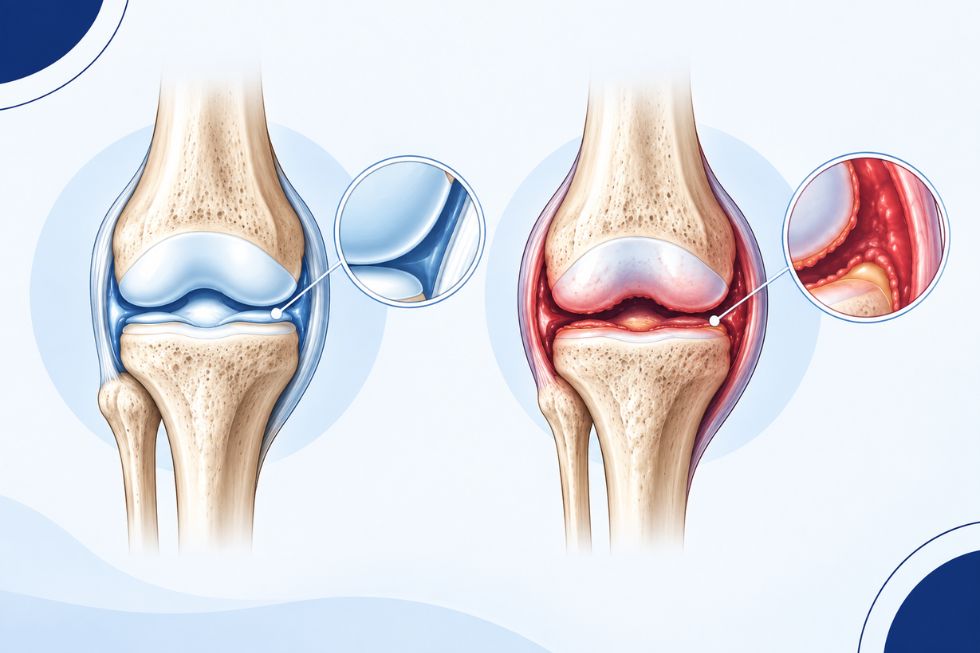
You may also hear the term inflammatory arthropathy, which describes the same underlying process. In simple terms, the immune system starts attacking the lining of a joint by mistake, or an infection or crystal deposit sets off inflammation that the body then struggles to switch off.
Almost any joint can be affected, though we most commonly see the hands, wrists, knees, hips, shoulders, feet and ankles.
IMPORTANT — When to seek urgent medical attention
Please do not wait for a routine appointment if you have:
- A single joint that is hot, very painful and swollen, especially with a fever or feeling generally unwell this can indicate a joint infection, which is a medical emergency.
- A new severe headache, scalp tenderness, jaw pain on chewing, or any change or loss of vision.
- Sudden inability to use or bear weight through a joint.
- Rapidly worsening pain, redness spreading from a joint, or new numbness or weakness.
Seek urgent medical attention:
Contact your GP urgently, call NHS 111, or attend
your nearest A&E.
This page provides general information only and is not a substitute for individual medical advice.
Inflammatory Arthritis vs Osteoarthritis: What Is the Difference?
| Feature | Osteoarthritis | Inflammatory Arthritis |
|---|---|---|
| Main cause | Largely driven by mechanical wear and changes in the joint over time. | Driven by active inflammation from the immune system, an infection, or crystal deposits. |
| Age | Becomes more common with increasing age. | Can begin at any age, including in young adults. |
| Morning stiffness | Usually lasts only a few minutes. | Often lasts 30 minutes or longer. |
| Other clues | Joint stiffness and discomfort are common features. | Morning stiffness may occur alongside fatigue or a low-grade temperature. |
Inflammatory Arthritis Symptoms
Patients describe symptoms in slightly different ways, but a pattern usually emerges:
● Deep, throbbing joint pain that is often worse first thing in the morning
● Visible swelling, with the joint feeling warm or tender to touch
● Stiffness that lingers well beyond 30 minutes after getting up
● Noticeably reduced movement in the affected joint
● Low energy, disturbed sleep or an occasional mild temperature
● Flares, where symptoms escalate suddenly and then settle for a period
Several different conditions share these features, which is exactly why a proper assessment by a rheumatologist matters before anyone starts treating symptoms on their own.
Request a call back
Types of Inflammatory Arthritis We Assess and Manage
Rheumatoid Arthritis (RA)
Rheumatoid arthritis develops when the immune system attacks the joint lining, typically in the hands, wrists and feet, and usually on both sides of the body at once.
The rheumatoid arthritis symptoms we see most often are joint swelling, pain that is worse in the morning, prolonged stiffness, and fatigue that does not lift with rest.
Rheumatoid arthritis treatment here begins with building a full clinical picture rather than moving straight to medication. From there, your consultant may bring in physiotherapy, practical lifestyle changes, and only where it genuinely fits your situation prescription treatment, fully explained before anything is agreed.
There is good evidence that earlier assessment and treatment in rheumatoid arthritis is associated with better long term joint outcomes, which is why we encourage patients not to wait.
Psoriatic Arthritis (PsA)
Some patients search for this under the name psoriasis arthritis; both terms describe the same condition. Psoriatic arthritis usually appears in people who already have psoriasis affecting their skin or nails, though joint symptoms can sometimes come first, and a family history of psoriasis is also relevant.
Psoriatic arthritis symptoms often include swollen, painful joints, nail changes such as pitting or lifting, swelling of a whole finger or toe, and tenderness where tendons attach to bone. Because disease activity in PsA can shift over months, we review patients regularly rather than setting a plan and leaving it unchanged.
Axial Spondyloarthritis and Ankylosing Spondylitis (AS)
Ankylosing spondylitis is now classified within a broader group of conditions called axial spondyloarthritis, which affects the spine and the joints linking the spine to the pelvis. The ankylosing spondylitis symptoms patients mention most are a deep ache in the lower back and buttocks, and stiffness that is worst after sleeping or sitting still and eases once they start moving. Symptoms often begin before the age of 45. Ankylosing spondylitis treatment at our clinic centres on maintaining spinal mobility through guided physiotherapy and a structured exercise routine agreed with you directly, alongside medical management where appropriate.
Gout and Calcium Pyrophosphate Deposition (Pseudogout)
| Feature | Gout | Calcium Pyrophosphate Deposition (Pseudogout) |
|---|---|---|
| Cause | Caused by urate crystals forming in a joint. | Caused by calcium pyrophosphate crystal deposition in a joint. |
| Common joints | Most often affects the base of the big toe, but can also affect the ankle, knee, hand or wrist. | More often affects the knee or wrist. |
| Typical attack | Attacks typically come on rapidly, often overnight, with intense pain, redness and swelling. | Can cause a similar picture with acute joint pain, redness and swelling. |
| Age | Can affect adults of different ages. | More commonly affects older adults. |
Gout is the most common form of inflammatory arthritis in the UK. It is caused by urate crystals forming in a joint, most often the base of the big toe, but also the ankle, knee, hand or wrist. Attacks typically come on rapidly, often overnight, with intense pain, redness and swelling.
Calcium pyrophosphate deposition (sometimes called pseudogout) causes a similar picture, more often in the knee or wrist and more commonly in older adults. Because a hot, swollen joint can also indicate infection, we assess these presentations
carefully. Management may include treating the acute attack, reviewing contributing factors such as diet, alcohol, weight and medications, and where appropriate discussing long term treatment to lower urate levels and reduce the risk of further attacks and joint damage.
Reactive Arthritis
Reactive arthritis follows an infection elsewhere in the body rather than starting on its own. It usually develops one to four weeks after a bowel or genitourinary infection, andcan affect the joints, the eyes and the urinary tract.
Because the trigger matters, our team reviews recent infections alongside the joint symptoms themselves, since treating any persisting infection properly is part of getting the joint symptoms under control.
Enteropathic Arthritis (Arthritis and IBD)
Patients living with inflammatory bowel disease sometimes develop joint symptoms too, and many arrive asking about the link between ulcerative colitis and arthritis, or Crohn’s disease and joint pain.
Enteropathic arthritis can involve the spine or the smaller joints and frequently flares alongside bowel symptoms. Because this sits between gastroenterology and rheumatology, we liaise with other specialists where it helps, so your care is not split between teams working in isolation.
Other Conditions We Assess
Our consultant also assesses and manages connective tissue disease, vasculitis and osteoporosis, and can arrange onward referral for specialist investigations where these are needed.
Your Care Pathway at Renew Skin & Health Clinic

Step 1 — Initial Consultation
Your first appointment is largely a conversation. Dr Kasavkar asks about your symptoms, your wider medical history and anything that concerns you, then carries outa hands on examination of the affected joints.
Step 2 — Investigations
Where the picture needs more detail, blood tests, scans or imaging are arranged to help confirm what is causing your symptoms.
Step 3 — Diagnosis and Treatment Plan
Dr Kasavkar talks you through what the results show in plain language, then discusses the treatment routes that genuinely fit your circumstances rather than a one size fits all approach.
Step 4 — Ongoing Care
Your progress is reviewed at follow up appointments, with your treatment plan adjusted as your condition changes.
Working with your GP. With your consent, we write to your GP after your consultation so that your wider medical care stays joined up. If you would prefer us not to, please tell us at your appointment.
Treatment Options
Depending on your condition and how it is affecting you, your plan may draw on:
● Medication management
● Joint injections, offered only where clinically appropriate following assessment
● Assessment and management of osteoporosis
● Practical lifestyle and exercise guidance
● Long term monitoring for inflammatory and autoimmune conditions
● Referral for specialist investigations where these are needed
No two patients receive an identical plan, because no two cases of inflammatory arthritis behave the same way. Where prescription treatment could help, your consultant explains the options in full during your consultation, and nothing is prescribed until a complete assessment has taken place. How well any individual responds varies from person to person, and we never promise a particular outcome. The aim of every plan is to ease your symptoms and protect your joints for the years ahead.
Meet Your Consultant Rheumatologist
Your care is led by Dr Ganesh Kasavkar, MBBS, MRCP, Rheumatology and General Internal Medicine (CCT), GMC Reg. No. 7436153, on the GMC Specialist Register for Rheumatology.

Dr Kasavkar has over 10 years’ experience in rheumatology and over 15 years in general internal medicine, and works as a full time consultant rheumatologist within the NHS. His practice spans rheumatoid arthritis, psoriatic arthritis, axial spondyloarthritis, connective tissue disease, vasculitis and osteoporosis, alongside procedures including peripheral joint injections.
Patients seeing Dr Kasavkar are involved directly in decisions about their own care, rather than being handed a plan with no explanation.
Consultation Fees
| Rheumatology Consultation | Fee |
|---|---|
| Initial rheumatology consultation | £230 |
| Follow-up consultation | £125 |
Why Choose Renew Skin & Health Clinic?
● Consultant led care. You are assessed by a consultant on the GMC Specialist Register for Rheumatology, not a generalist.
● CQC registered. Renew Skin & Health Clinic Ltd is registered with and inspected by the Care Quality Commission.
● Established locally. We have been caring for patients in Royal Leamington Spa for over 15 years.
● Time to be heard. Appointments are unhurried, questions are answered properly, and you leave knowing what happens next
Book Your Rheumatology Consultation in Leamington Spa
Ongoing joint pain, swelling or stiffness rarely improves by waiting it out. If any of this sounds familiar, contact us to arrange a consultation with our consultant rheumatologist. The earlier your condition is properly assessed, the more options are usually available to manage it well.
We see patients from across Warwickshire and the West Midlands, including Leamington Spa, Warwick, Kenilworth, Coventry, Stratford upon Avon, Rugby, Southam and Solihull.
Renew Skin & Health Clinic
18 Guy Street, Royal Leamington Spa, CV32 4RT
Telephone: +44 1926 422 454 · Email:
References and Further Information
● National Institute for Health and Care Excellence (NICE) NG100 — Rheumatoid arthritis in adults: management
● NICE NG65 — Spondyloarthritis in over 16s: diagnosis and management
● NICE NG219 — Gout: diagnosis and management
● NICE Clinical Knowledge Summaries — Psoriatic arthritis
● Versus Arthritis — patient information on inflammatory arthritis
● NHS — Arthritis
This page is for general information and does not replace personalised medical advice.
Renew Skin & Health Clinic Ltd is registered with the Care Quality Commission.
Company No. 07359901.
Frequently Asked Questions (FAQs)
1. What is inflammatory arthritis, in simple terms?
It is a group of joint conditions where ongoing inflammation, rather than everyday wear and tear, causes pain and swelling. The trigger can be the immune system, an infection or crystal deposits. Your consultant works out which applies to you before recommending a plan.
2. Which symptoms should prompt a visit to a specialist?
Joint pain that will not settle, visible swelling, around a joint, stiffness lasting well beyond 30
minutes in the morning, and unexplained fatigue are all worth having assessed — particularly once they have persisted for more than a couple of weeks. A
single hot, very painful joint with fever needs urgent, same-day medical attention.
3. How do I know if it is inflammatory arthritis rather than osteoarthritis?
Osteoarthritis develops gradually and is largely mechanical, while inflammatory arthritis is driven by active inflammation and can affect people of almost any age. Morning stiffness lasting more than 30 minutes is a useful pointer, but only a clinical assessment, usually with blood tests or imaging, can give a definitive answer.
4. What are the most common rheumatoid arthritis symptoms?
Symmetrical swelling and pain, often in the hands and feet on both sides, prolonged morning stiffness, and fatigue that does not improve with sleep. Your consultant confirms the pattern before discussing rheumatoid arthritis treatment with you.
5. Is psoriasis arthritis the same as psoriatic arthritis?
Yes. Both terms describe the same condition: joint inflammation occurring alongside, or sometimes before, the skin or nail changes associated with psoriasis. Not everyone with psoriasis develops arthritis, but if joint symptoms appear it is sensible to have them reviewed.
6. What ankylosing spondylitis symptoms tend to appear first?
Lower back and buttock pain with stiffness that is worst after rest and eases with movement, usually beginning before the age of 45. Ankylosing spondylitis mainly affects the spine and pelvis, and earlier assessment tends to make ongoing management more straightforward.
7. Does ankylosing spondylitis treatment help in the long term?
Treatment centres on maintaining spinal mobility through physiotherapy and a structured exercise
plan built with your consultant, alongside medical management where appropriate. Everyone responds differently, and your consultant will discuss what is realistic for your circumstances.
8. Is gout a form of inflammatory arthritis?
Yes. Gout is caused by urate crystals forming in a joint and is the most common inflammatory arthritis in the UK. Attacks usually come on rapidly with severe pain, redness and swelling, most often in the big toe. Because a hot swollen joint can also mean infection, it should be assessed promptly.
9. What causes reactive arthritis?
It typically follows a bowel or genitourinary infection, developing one to four weeks later and sometimes affecting the eyes and urinary tract as well as the joints. Our team reviews your recent medical history alongside your current symptoms.
10. Can ulcerative colitis and arthritis be connected?
Yes. Some patients with inflammatory bowel disease, including ulcerative colitis and Crohn’s disease, develop a related joint condition called enteropathic arthritis. If you have IBD and joint pain, our rheumatology team can assess whether the two are linked.
11. Do I need a GP referral?
A GP referral is helpful but not essential. If you have
recent blood tests, scans or letters, please bring them to your appointment.
12. What happens after my first appointment?
You move through a clear process: consultation, investigations if needed, a diagnosis and treatment plan discussion, then ongoing follow-up. Depending on your condition, the plan may include medication management, joint injections where appropriate, lifestyle guidance or long-term monitoring.