
Nevus of Ota (Oculodermal Melanocytosis) Treatment in Leamington Spa
HOME /Nevus of Ota (Oculodermal Melanocytosis) Treatment in Leamington Spa
Q-Switched Laser Treatment for Nevus of Ota
Nevus of Ota also called oculodermal melanocytosis is a benign skin pigment condition that produces a distinctive blue grey or brown discolouration typically affecting one side of the face. It is a condition that is present from birth or early life in the majority of cases, and it can cause significant self consciousness and emotional distress because of its visible location on the face.
At Renew Skin and Health Clinic in Leamington Spa, we offer specialist nevus of ota treatment using Q-switched laser technology the most clinically validated approach currently available for this condition. All patients begin with a thorough assessment by Dr. Jha, a GMC-registered Cosmetic Physician (GMC No. 5170447) with close to 35 years of specialist experience in laser dermatology.
Treatment begins from £250 per session. Most patients require 10 to 15 sessions or more to reach an acceptable level of clearance. This is a condition that demands patience and we believe in being completely honest with every patient about what treatment involves and what it can realistically achieve.

Nevus of Ota Laser Treatment at a Glance
What Is Nevus of Ota?

Nevus of Ota, clinically known as oculodermal melanocytosis, is a dermal melanocytosis a condition in which pigment producing cells called melanocytes are located deep within the dermis rather than in the superficial layers of the skin where they are normally found. This unusual position of the pigment cells is what produces the characteristic blue grey or brown skin discoloration associated with the condition.
The discolouration typically appears on one side of the face following the distribution of the trigeminal nerve, affecting the eye area, temple, forehead, cheek, and nose. It may also involve the sclera the white of the eye giving it a blue or grey tint. The condition is usually unilateral, meaning it affects one side of the face only.
A nevus on face of this type is more common in people of Asian and African descent and affects women significantly more often than men. In most cases it is present from birth or becomes noticeable within the first year of life, though it may intensify during puberty, pregnancy, or with prolonged skin darkening through sun exposure.
Nevus of Ota is entirely benign it has no malignant potential and does not require treatment from a medical standpoint. However, because it appears prominently on the face, many patients find it causes significant emotional and psychological distress, and treatment is chosen for cosmetic and quality of life reasons.
What Causes Nevus of Ota?
The nevus of ota causes are related to the abnormal positioning of melanocytes during embryonic development. In a person with Nevus of Ota, melanocytes that should have migrated to the superficial layers of the skin remain instead in the deeper dermis. These deep melanocytes produce melanin the pigment responsible for skin discoloration which manifests as the characteristic blue grey colouration seen at the skin’s surface.
This is not caused by sun damage, infection, diet, or lifestyle. It is a congenital developmental variation, and in the majority of patients it is present from birth or early childhood. The condition cannot be prevented. The causes of pigmentation in this case are entirely developmental in nature rather than environmental.
Clinical Monitoring Recommendation — Nevus of Ota and Eye Health
Although Nevus of Ota is a benign condition, patients with scleral involvement where the white of the eye appears blue or grey should be aware of a slightly elevated risk of glaucoma.
A small number of patients with extensive Nevus of Ota have also been found to have a marginally increased risk of uveal melanoma, a rare eye tumour.
This does not mean these conditions are likely. The absolute risk remains low. However, periodic ophthalmic examinations are recommended for patients with scleral involvement to allow early detection of any changes.
Dr. Jha will discuss this with you during your initial assessment and advise on whether ophthalmic monitoring is appropriate in your individual case.
How Is Nevus of Ota Treated?
The most clinically effective treatment for nevus of ota is Q-switched laser therapy. This is a highly specific type of laser that delivers energy in very short, intense pulses, targeting the deep dermal melanocytes responsible for the pigmentation without significantly affecting the surrounding skin tissue.
At Renew Skin and Health Clinic, nevus of ota laser treatment is delivered using a Q-switched Nd:YAG laser one of the most established and well evidenced laser platforms for treating dermal pigmentation conditions of this type. The laser energy is absorbed by the melanin in the deep melanocytes, breaking down the pigment into smaller particles that the body’s immune system gradually removes naturally.
Request a call back
Why Multiple Sessions Are Always Required
This is one of the most important things to understand about nevus of ota removal. Because the melanocytes are located in the deep dermis rather than the superficial skin layers, the laser must work gradually over many sessions. It is not a condition that responds to two or three treatments. Most patients require between 10 and 15 sessions or more to reach an acceptable level of clearance, spaced 6 to 8 weeks apart to allow the body’s immune system time to clear the broken down pigment between sessions.
Significant improvement is typically visible after 4 to 6 sessions. Full clearance is achievable in many cases, but the degree of clearance varies between individuals depending on the depth and density of the pigmentation, the patient’s skin type, and how well they protect the area from sun exposure between treatments.
We will always tell you honestly at your initial assessment what you can realistically expect from treatment. We do not overstate outcomes or suggest that complete clearance is guaranteed. Our clinical approach is built on transparent, honest information so that you can make a fully informed decision before any treatment begins.
Q-Switched Laser vs Other Approaches
| Approach | How It Works | Suitability for Nevus of Ota |
|---|---|---|
| Q-switched Nd:YAG laser | Very short, intense pulses of laser energy target deep dermal melanocytes precisely | First-line treatment. Most clinically evidenced. Used at Renew Skin and Health Clinic. |
| Q-switched Alexandrite laser | Targets melanin with a different wavelength suitable for certain skin types | Effective, particularly in lighter skin tones. Discussed at consultation. |
| Pico laser | Ultra short pulse duration that breaks pigment into very fine particles | Increasingly used for dermal pigmentation. Can reduce session numbers compared to older Q-switched technology. |
| Topical creams and bleaching agents | Surface acting products that target epidermal surface pigment | Minimal benefit for Nevus of Ota. Pigment is too deep for topical agents to reach. |
| Surgical excision | Physical removal of the affected skin | Not appropriate for Nevus of Ota. Would cause significant scarring without reliable clearance of deep pigment. |

Sun Protection and Aftercare — Why It Matters for Nevus of Ota Treatment
Sun protection is not optional during nevus of ota treatment it is essential. Ultraviolet exposure stimulates melanocytes to produce more pigment, which can directly counteract the progress made by laser sessions. Patients who do not apply broad spectrum SPF 50 sunscreen consistently between sessions are significantly less likely to achieve good outcomes.
Our recommended aftercare protocol includes:
• Strict daily application of SPF 50 broad spectrum sunscreen to the treated area even on cloudy days and indoors near windows
• Avoiding direct sun exposure to the treated area for at least 4 weeks following each laser session
• Not picking or rubbing the treated skin following a laser session
• Attending all sessions at the recommended 6 to 8 week intervals gaps longer than this reduce the cumulative effect of treatment
• Attending regular eye examinations if scleral involvement is present this should continue independently of your laser treatment course
Nevus of Ota Treatment Cost — What to Expect
At Renew Skin and Health Clinic, nevus of ota laser treatment is priced from £250 to £500 per session. The cost per session depends on the size of the treatment area, the laser platform used, and the specific parameters required for your skin type. An accurate session price is confirmed at your initial assessment with Dr. Jha.
| Treatment | Price |
|---|---|
| Q-switched laser session (standard area) | From £250 per session |
| Q-switched laser session (larger area) | From £500 per session |
| Estimated full course (10 to 15 sessions) | £2,500 to £7,500 total (guide only) |
| Initial consultation with Dr. Jha | Complimentary (weekdays) |
The estimated total course cost is provided as a guide only. Some patients require fewer sessions and some may require more. A realistic treatment plan and session estimate is provided at your consultation. There are no hidden fees.
Consultation Fees & Treatment Charges
At Renew Skin and Health Clinic, we believe in complete transparency at every stage of your treatment journey. Below is a clear breakdown of consultation and procedure fees.
| Service | Weekdays | Weekends & Bank Holidays |
|---|---|---|
| Initial Consultation (Dr. Jha) | Complimentary | £75 |
| Laser Treatment Session | From £250 per session | Additional £150 (weekends only) |
For more details, please Call us +44 1926 422 454 or Connect on WhatsApp +44 1926 422 454.
Clinical Assessment by Dr. Jha
All Nevus of Ota consultations and clinical assessments at Renew Skin and Health Clinic are carried out by Dr. Nawal Kishore Jha. Laser treatment sessions are delivered by our qualified laser therapist under Dr. Jha’s clinical oversight.

Dr. Nawal Kishore Jha
Cosmetic Physician, GMC No. 5170447
Dr. Jha is a GMC-registered Cosmetic Physician with close to 35 years of specialist experience in laser and aesthetic medicine, with a particular focus on hair restoration. He is an Associate Member of the International Society of Hair Restoration Surgery (ISHRS) a globally recognised professional body dedicated to hair loss treatment reflecting his specific commitment to this speciality.
Dr. Jha graduated with a Bachelor of Medicine and Surgery (MBBS) from the University of Ranchi, India, in 1992 and moved to the United Kingdom in 1996, where he has worked in NHS and private clinical practice. He has developed extensive expertise across advanced laser platforms including CO2, Nd-Yag, Pulsed Dye, IPL, Excimer, and Alex laser.
He is a member of the British Medical Association (BMA) and the Independent Doctors Forum (IDF). To learn more, visit his specialist profile
Why Choose Renew Skin and Health Clinic for Nevus of Ota Treatment?
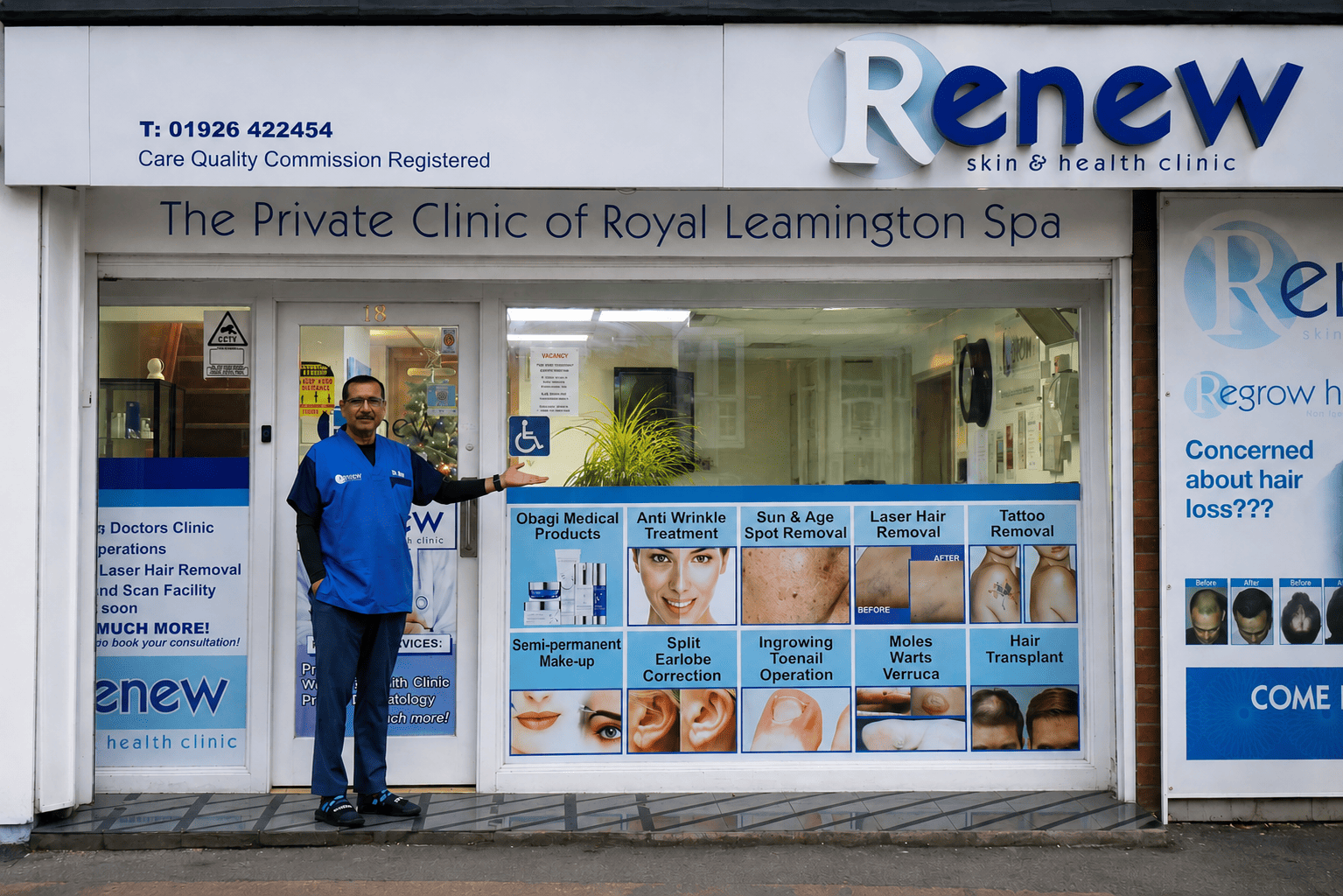
• Dr. Jha — GMC-registered (GMC No. 5170447), close to 35 years of specialist laser dermatology experience, with specific expertise in Nd:YAG and Q-switched laser for skin pigmentation conditions
• Honest clinical assessment we will tell you precisely what is achievable for your specific Nevus of Ota before any treatment begins
• Transparent pricing from £250 per session, with a full course estimate provided at your free initial consultation
• Qualified laser therapist delivering all treatment sessions under direct clinical oversight
• CQC-registered private clinic in Leamington Spa accessible from Coventry, Birmingham, Warwick, and Rugby
• Free initial consultation available on weekdays
For our full range of laser and pigmentation treatments, please visit our laser skin resurfacing, our skin blemishes, or our birthmark removal. For related pigmentation conditions you may also want to view our port wine stain removal.
Nevus of Ota Treatment Near Leamington Spa
18 Guy Street, Leamington Spa CV32 4RT
Show map
Patients searching for nevus of ota treatment near me in the Midlands regularly choose Renew Skin and Health Clinic in Leamington Spa. We offer specialist Q-switched skin clinic laser treatment for this condition in a private, CQC-registered clinical setting. Our clinic is easily accessible from Coventry, Birmingham, Warwick, Rugby, Stratford upon Avon, and across Warwickshire.
Finding a specialist who has genuine experience with Nevus of Ota is more important than finding a clinic that is simply close by. Dr. Jha’s close to 35 years of laser dermatology practice and his specific expertise with the Nd:YAG and Q-switched platforms used for dermal melanocytosis make Renew Skin and Health Clinic one of the most experienced providers for this condition in the Midlands region.
Book Your Free Nevus of Ota Consultation with Dr. Jha
Your consultation with Dr. Jha will include a thorough clinical assessment of your Nevus of Ota, an honest discussion of what treatment can achieve for your specific case, and a transparent session estimate and cost breakdown.
No obligation to proceed. Free on weekdays.
- Call: +44 1926 422 454
- Email:
- Address: Renew Skin & Health Clinic
18 Guy Street, Leamington Spa, CV32 4RT. United Kingdom. - Whatsapp: +44 1926 422 454
- Opening Hours: Monday to Friday, 10:00 AM – 6:00 PM (Telephone lines open daily 9:00 AM – 10:00 PM, including weekends)
Frequently Asked Questions (FAQs)
1. What is Nevus of Ota?
Nevus of Ota, also known as oculodermal melanocytosis, is a benign skin pigment condition caused by melanocytes pigment producing cells remaining in the deep dermis rather than migrating to the surface of the skin during development. This produces a blue grey or brown discolouration typically affecting one side of the face around the eye, cheek, temple, and nose. It is present from birth or early life in most cases and is more common in people of Asian and African descent.
2. Is Nevus of Ota dangerous or harmful?
Nevus of Ota is benign and has no malignant potential. It is not harmful and does not require treatment from a medical standpoint. However, patients with scleral involvement where the white of the eye has a blue-grey tint carry a marginally elevated risk of glaucoma and, very rarely, uveal melanoma. For this reason, Dr. Jha recommends periodic ophthalmic monitoring for patients where the eye is involved.
3. What is the best treatment for Nevus of Ota?
The most clinically effective and well-evidenced treatment for nevus of ota is Q-switched laser therapy — specifically Q-switched Nd:YAG or Alexandrite laser. These lasers deliver short, intense pulses that target and break down the deep dermal melanocytes responsible for the pigmentation. At Renew Skin and Health Clinic, Q-switched Nd:YAG laser is the primary treatment modality used for this condition.
4. How many laser sessions are needed for Nevus of Ota?
Most patients require between 10 and 15 nevus of ota laser treatment sessions or more to reach an acceptable level of clearance. Sessions are spaced 6 to 8 weeks apart to allow the body’s immune system time to remove the broken-down pigment between treatments. Significant improvement is typically visible from session 4 to 6 onwards, but the full result develops progressively over the entire treatment course.
5. How much does Nevus of Ota laser treatment cost in the UK?
At Renew Skin and Health Clinic in Leamington Spa, nevus of ota treatment costs from £250 to £500 per session depending on the size of the area being treated and the laser parameters required. Most patients need 10 to 15 sessions or more. The total course cost typically ranges from £2,500 to £7,500 or above. A personalised cost estimate is provided at your free initial consultation with Dr. Jha.
6. Is Nevus of Ota laser treatment painful?
Q-switched nevus of ota laser treatment involves a sensation commonly described as a sharp snapping feeling against the skin during each pulse. A topical numbing cream is applied beforehand to reduce discomfort. Most patients find the procedure tolerable. The sensation varies depending on the area being treated and individual sensitivity. Our laser therapist adjusts treatment parameters to keep discomfort to a minimum throughout each session.
7. Can Nevus of Ota be completely removed?
Significant fading and a high level of clearance is achievable in most patients with nevus of ota removal using Q-switched laser. However, whether complete clearance is achievable depends on factors including the depth and density of the pigmentation, the patient’s skin type, and how consistently sun protection is maintained between sessions. Dr. Jha will give you an honest assessment of the likely outcome for your specific case at your consultation we do not overstate what treatment can achieve.
8. Why does Nevus of Ota need so many laser sessions?
Nevus of Ota requires multiple sessions because the melanocytes are located deep within the dermis. Each laser session breaks down a portion of the pigment and the body’s immune system gradually removes it over the following weeks. The process cannot be accelerated beyond what the body can safely clear between sessions, which is why the 6 to 8 week interval between sessions is clinically important and should not be shortened.
9. Can topical creams treat Nevus of Ota?
Topical creams and bleaching agents have minimal benefit for nevus of ota because the melanocytes responsible for the pigmentation are located deep in the dermis — well beyond the reach of any topical product. Surface-acting creams can only affect pigment in the superficial epidermis. Laser treatment is the only effective way to reach and disrupt the deep pigment cells in this condition.
10. How do I book a Nevus of Ota consultation near me in Leamington Spa?
You can book a free nevus of ota treatment near me consultation with Dr. Jha at Renew Skin and Health Clinic by calling or WhatsApp messaging +44 1926 422 454, or by emailing info@renewskinandhealthclinic.co.uk. Weekday consultations are complimentary. We welcome patients from Leamington Spa, Coventry, Birmingham, Warwick, Rugby, and across Warwickshire. Same day appointments are available in most cases.
Request a call back
Book Now
A brief about your case / Request call back
You could share a brief about your case or if you are occupied at the moment, feel free to request a call back by filling the form left:
Book Free Consultation
If you have any questions or interested to discuss your case with our specialist, please call or WhatsApp.
Opening Hours
Monday – Friday: 10.00 AM – 6.00 PM
Weekends: Appointments only on request via reception!
Telephone lines open daily from 9:00 AM – 10:00 PM, including weekends)


