

At first glance, discovering any small growth on your skin often raises a question about its identity: mole or skin tag? These two conditions often appear similar and form for different reasons and require different solutions for removal and management.
Understanding moles and skin tags properly is the first step to knowing whether a growth needs monitoring, removal, or simply no action at all.
At Renew Skin & Health Clinic in Leamington Spa, our specialists are asked this exact question during consultations regularly. This guide breaks down the real differences between the two, walks through the various types of skin tags you might notice, and explains when either one is worth having professionally assessed.
What Is a Mole?
Mole formation occurs when pigment producing skin cells, known as melanocytes, clump together in one area. Most moles are flat or only slightly raised with smooth surfaces and an even color palette ranging from brown, black, or reddish hues. Moles often emerge during childhood or early adulthood and persist for years afterward.
Common features of a normal mole include:
- A round or oval shape and welldefined edges
- Consistent color throughout and no noticeable changes over time
- No symptoms such as pain, bleeding, or itching when present in normal circumstances
- Normal moles typically present no health concerns for their owners.
What Is a Skin Tag?
A skin tag, medically known as an acrochordon, is a soft growth of skin that hangs off the surface, usually attached by a thin stalk. Unlike a mole, a skin tag is not made of pigment cells; it is simply excess skin tissue, often forming where skin regularly rubs against skin or clothing.
Common features of a skin tag include:
- A soft, fleshtoned or slightly darker appearance
- A smooth or slightly wrinkled texture
- A tendency to appear on the neck, armpits, eyelids, chest, and groin
- Little to no pain, though they can become irritated by friction
Moles and Skin Tags: Key Differences at a Glance
The clearest way to understand moles and skin tags is to compare them side by side.
| Feature | Moles | Skin Tags |
|---|---|---|
| Underlying Cause | Clusters of pigment producing cells (melanocytes). | Excess skin tissue, often linked to friction. |
| Texture | Flat or slightly raised and firm. | Soft, often hanging from a thin stalk. |
| Attachment | Sits within the skin. | Usually attached by a narrow stalk. |
| Colour | Brown, black, or reddish. | Flesh toned or slightly darker. |
| Common Locations | Face, back, arms, and legs. | Neck, armpits, eyelids, chest, and groin. |
| Growth Pattern | Usually stable for years. | Can increase in number over time. |
| Risk Consideration | Requires monitoring for changes. | Generally not linked to skin cancer. |
| Typical Management | Monitoring or removal if changing or unwanted. | Removal for comfort or cosmetic reasons. |
Types of Skin Tags
Not every skin tag looks or behaves the same way. Understanding the different types of skin tags can help you recognise what you are dealing with before deciding whether removal is worthwhile.
1. Filiform Skin Tags: Thin, threadlike growths that often appear around the eyelids, neck, or face.
2. Acrochordons (Common Skin Tags): The most typical form, generally small, soft, and rounded, frequently found in the armpits, groin, and neck.
3. Fibroepithelial Polyps: These larger skin tags often feature a wider base.
4. Clustered Skin Tags: Multiple small tags clustered closely together are most frequently seen on skin folds such as underarms or the groin.
5. Pedunculated Skin Tags: Tags with a distinctly narrow stalk, which can sometimes twist and become tender or discoloured.
While these types vary slightly in appearance, all skin tags share the same underlying cause and are considered harmless.
How Can You Tell Them Apart?
If you are trying to work out whether you have a mole or a skin tag, ask yourself the following:
- Does it hang off the skin on a stalk, or is it flat against the skin? A hanging growth is more likely a skin tag; a flat or slightly raised mark is more likely a mole.
- Is it pigmented brown or black, or is it fleshcoloured? Pigmentation points toward a mole, while a fleshtoned appearance points toward a skin tag.
- Where is it located? Skin tags favour areas of friction such as the neck, underarms, and eyelids, while moles can appear almost anywhere on the body.
- Has it changed recently? Skin tags rarely change once formed, whereas any recent change in a mole’s size, shape, or colour should always be checked.
If you are still unsure after considering these points, a professional assessment is the only reliable way to confirm what you are dealing with.
Are Moles or Skin Tags Dangerous?

Skin tags are considered entirely benign and are not linked to skin cancer. Moles are also overwhelmingly harmless, but because they are made of pigment cells, they require a slightly higher level of attention. A mole that changes in size, develops an irregular border, bleeds, itches, or appears suddenly in adulthood should always be assessed by a specialist to rule out anything more serious.
When Should You See a Specialist?
You should book a professional assessment if you notice:
- A new mole appearing in adulthood
- Any mole changing in colour, shape, or size
- A skin tag becoming sore, twisted, or repeatedly irritated by clothing or jewellery
- Uncertainty about whether a growth is a mole, skin tag, or something else entirely
At Renew Skin & Health Clinic, a free consultation allows our specialists to confirm the diagnosis and recommend the most suitable option, whether that is simple monitoring or removal.
Related Skin Concerns We Treat
Patients frequently consult us about other visible skin conditions during their consultation visit to Leamington Spa clinic, such as moles and skin tags. For these issues, we offer expert care such as:
- Yellowish plaques around the eyelids, addressed through xanthelasma treatment using precise laser technology.
- A soft, dark bluepurple mark on the lip caused by a dilated vein, known as a venous lake, including the more specific venous lake lip presentation.
- Viral, contagious growths in the genital area, treated through Genital Wart Removal.
- General moles anywhere on the body, from small facial moles to larger raised moles, assessed and treated with modern dermatology techniques.
- If thinning hair is also a concern alongside a skin change, our hair loss treatment service is available too.
If you are ever unsure whether a mark on your skin needs professional attention, our team is happy to assess it during a free consultation.
Why Choose Renew Skin & Health Clinic?
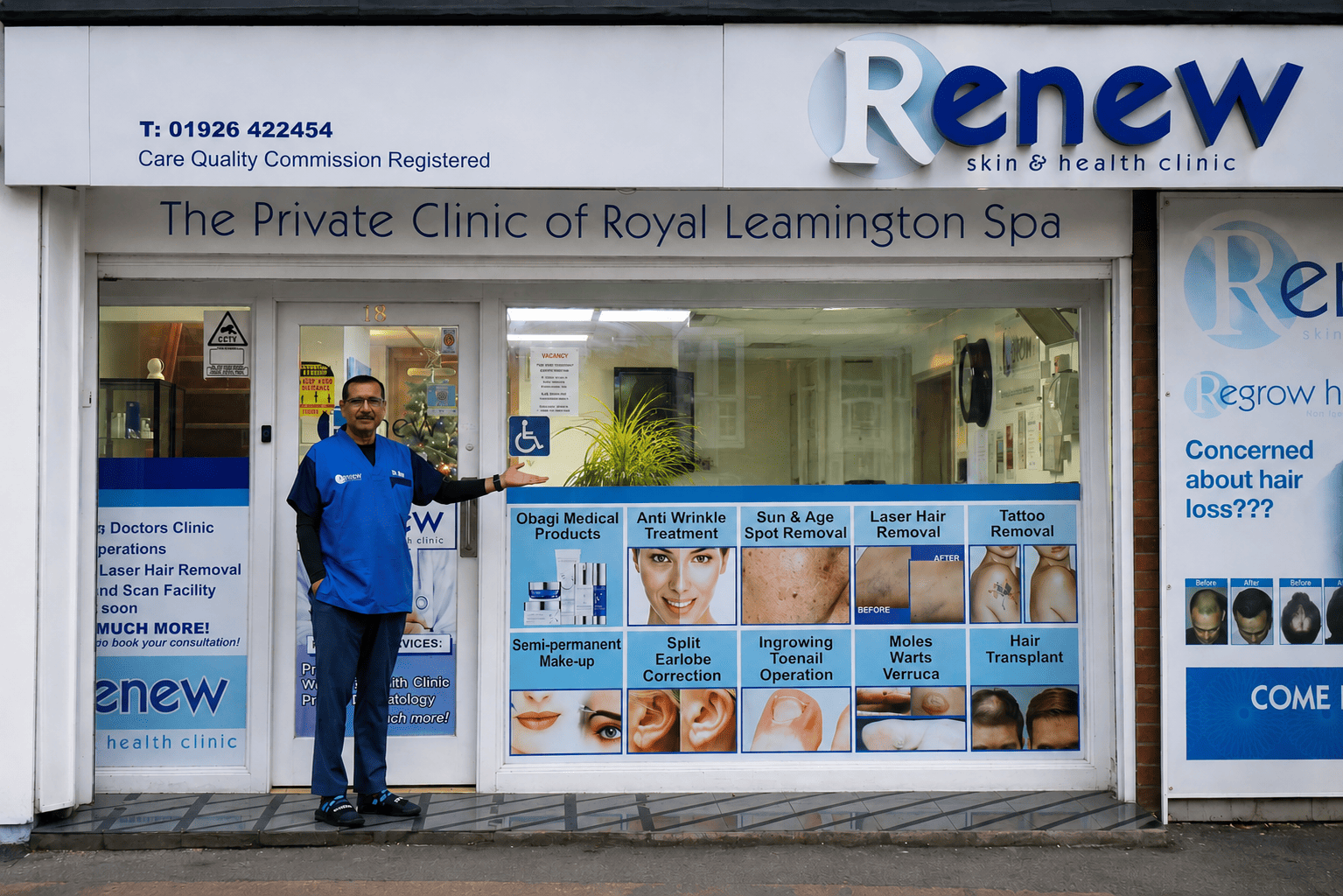
Led by Dr Nawal Kishore Jha, a Cosmetic Physician with over 35 years of clinical experience, Renew Skin & Health Clinic has been trusted by patients across the UK since 2010. Patients choose us for:
- CQC Registered Clinic
- Certified Medical Staff
- Same Day Appointments
- 24/7 Doctor Aftercare
- Free consultation before any treatment is agreed
- Advanced laser and surgical options tailored to each case
No matter your skin concern moles or tags our specialists can confirm a diagnosis and direct you towards taking the next steps necessary.
Request a call back
Book Your Free Consultation Today
If you are unsure whether a growth on your skin is a mole or a skin tag, our specialists at Renew Skin & Health Clinic are here to help with an honest, professional assessment.
- Call:+44 1926 422 454
- Email:
- Address: 18 Guy Street, Leamington Spa, CV32 4RT, United Kingdom
- Whatsapp: +44 1926 422 454
Frequently Asked Questions
1. What is the main difference between moles and skin tags?
Moles form from clusters of pigment producing cells and usually sit flat or slightly raised within the skin, while skin tags are soft growths of excess skin tissue that typically hang from a thin stalk.
2. Can a mole turn into a skin tag, or vice versa?
No. Moles and skin tags develop from entirely different types of skin cells, so one cannot turn into the other over time.
3. What are the most common types of skin tags?
The most common types include filiform (threadlike) tags, acrochordons, fibroepithelial polyps, clustered tags in skin folds, and pedunculated tags with a narrow stalk.
4. Are skin tags a sign of an underlying health condition?
Skin tags themselves are harmless, though they are sometimes more common in people with insulin resistance, diabetes, or those who are overweight. They are not, on their own, a diagnosis of any condition.
5. Do moles or skin tags need to be removed?
Either one may require removal if they cause discomfort, irritation, or cosmetic concerns, or show signs of change that warrant further investigation.
6. How can I tell if a growth is a mole or a skin tag at home?
Consider whether it hangs from a stalk (which could indicate skin tags) or sits flat against the skin and has pigmentation (more likely moles). If in doubt, professional assessment is recommended as this will provide accurate identification.
7. Can skin tags spread to other parts of the body?
Skin tags are noncontagious and do not spread to new areas; however, over time more tags may form in areas exposed to friction.
8. Is it safe to remove a mole or skin tag at home?
Home removal should not be attempted without professional medical assistance, as this can lead to bleeding, infection, or scarring; and in the case of moles, may prevent proper diagnosis should further investigation be necessary.
9. When should a mole be urgently checked by a doctor?
Any mole that changes size, shape or colour, develops an irregular border, bleeds profusely or first appears during adulthood should be assessed quickly by a specialist.
10. How can I book a consultation to check a mole or skin tag at Renew Skin & Health Clinic?
You can call +44 1926 422 454, WhatsApp the same number, or email info@renewskinandhealthclinic.co.uk to arrange a free consultation at 18 Guy Street, Leamington Spa, CV32 4RT.