

If you have noticed small, dark red, purple, or blackish bumps on your skin and started researching treatment, you have probably come across the phrase angiokeratoma before and after while looking for reassurance that laser treatment actually works. Seeing genuine results from real patients is often far more reassuring than reading a clinical description alone, especially when the lesion sits in a sensitive area.
At Renew Skin & Health Clinic in Leamington Spa, we treat angiokeratoma, including angiokeratoma of Fordyce, using advanced laser technology under the direct supervision of Dr Nawal Kishore Jha. In this guide, we explain what these lesions are, what real patient results typically look like, and what you can expect from consultation through to full healing.
What Is Angiokeratoma?
Angiokeratoma refers to a group of harmless vascular skin lesions that develop when small blood vessels close to the skin’s surface become dilated. They appear as dark red, blue, purple, or black raised bumps, and the surface can become slightly rough or scaly as the lesion matures.
These lesions are benign, non infectious, and not sexually transmitted. However, because of where they often appear and how they look, many patients feel embarrassed or worried before ever having them properly assessed.
Understanding Genital Angiokeratoma
Angiokeratoma is most often seen in the genital region for both women and men. In women, it is usually found in the vulval area, whereas in men, it is usually located on the scrotal surface. As Dr. Jha states, these lesions are harmless blood vessel changes; however, because they may resemble different skin disorders, a medical examination will always provide the most precise solution and peace of mind.
What Causes Angiokeratoma?
The exact trigger is not always identifiable, but several contributing factors are well recognised:
- Increased local blood pressure within small vessels
- Fragile or dilated superficial blood vessels
- Genetic tendencies
- Rare underlying conditions, such as Fabry’s disease
- Age related vascular changes
- Long term friction or irritation in the affected area
Symptoms and Appearance
Most people have one or more of the following symptoms:
- Small dome shaped raised bumps
- Colors range from vibrant red to deep purple or black
- A rough, slightly keratotic surface that is present in mature lesions
- Sometimes, there is bleeding after shaving or friction
- Mild discomfort in certain instances
While angiokeratoma usually occurs on the genital area, it can also be seen on the abdomen, inner thighs and lower limbs, as well as occasionally, the upper part of the body.
Angiokeratoma Before and After: What Real Results Typically Show
Patients researching angiokeratoma before and after results are usually looking for two things: whether the lesion visibly reduces or disappears, and how natural the skin looks afterwards. At Renew Skin & Health Clinic, laser treatment works by targeting the dilated blood vessels inside the lesion. The light energy safely coagulates the vessel while leaving the surrounding skin largely unaffected, which allows for precise removal with minimal downtime.
In our clinical experience, most patients see a clear, positive difference after their first laser session, with the treated area appearing flatter, lighter in colour, and considerably less noticeable within a few weeks of healing. Larger lesions or multiple clusters may need a second session for the best possible outcome. Full before and after images from real female and male patients treated at our Leamington Spa clinic are available to view on our dedicated angiokeratoma treatment page, alongside video interviews from patients who have been through the process.


What Happens If Angiokeratoma Is Left Untreated?
Angiokeratoma lesions do not disappear on their own. Left untreated, they may enlarge, increase in number, or bleed more frequently over time. Some patients also find that the lesions become irritated by clothing, a source of ongoing anxiety, or are mistaken for a sexually transmitted infection, which adds unnecessary worry when the underlying cause is simply vascular.
Angiokeratoma of Fordyce vs Fordyce Spots: Know the Difference
| Feature | Angiokeratoma of Fordyce | Fordyce Spots |
|---|---|---|
| Underlying Cause | Widened surface blood vessels (vascular) | Visible sebaceous (oil) glands |
| Colour | Dark red, purple, or deep blue | Pale, cream, white, or yellowish |
| Surface Feel | Firm, slightly rough, or raised | Smooth, soft, and small |
| Common Areas | Scrotum, penile shaft, or vulval area | Lips, inner cheeks, penis, or labia |
| Bleeding Risk | Can bleed if irritated or traumatised | Does not bleed |
| Contagious? | No | No |
How Is Angiokeratoma Diagnosed?
Diagnosis is usually clinical, meaning an experienced specialist can identify angiokeratoma through a visual examination. In rare or uncertain cases, a dermatoscopy or biopsy may be carried out to rule out other conditions with a similar appearance.
Your Angiokeratoma Removal Treatment Journey at Renew
Each case is evaluated in a distinct way prior to the commencement of treatment. In the course of your visit, Dr. Jha will assess the affected area and examine the problems you are facing in a private and private setting, and suggest the best procedure based on the size of the lesion as well as its size and location.
The most important aspects of the treatment’s journey include:
- Sessions are required: The majority of patients see excellent results after one session. However, larger or multiple clusters may require another session.
- Recover: Most people can resume normal activities as soon as they are and are fully healed in several days.
- Recurrence: Not common, but it is possible. New lesions, if they do appear, are usually smaller and less difficult to treat.
- Aftercare: Patients are advised to not shave the area of treatment for 7-10 days until the skin is completely.
- Pricing: Treatments start at PS695, and a clear breakdown at the time of consultation. Saturday and bank holiday appointments are charged an additional fee, and 0% finance is available through an initial PS195 deposit.
Related Skin Concerns We Treat
Patients who come to us for angiokeratoma often ask about other visible skin or vascular changes at the same time. Our Leamington Spa clinic also provides expert assessment and treatment for:
- Small, firm bumps typically found on the nose or face, for which patients often search for fibrous papule removal near me; our specialists offer both laser reduction and, where needed, surgical removal.
- A soft, dark blue purple mark on the lip caused by a dilated vein, known as a venous lake or, more specifically, a venous lake lip, which is treated using precise laser therapy.
- Raised, overgrown scar tissue after an injury or piercing, including small keloid scars, is treated with laser therapy, steroid injections, or surgery, depending on severity.
- Concerns around moles in genital area, which we assess and treat with the same discretion and care given to genital angiokeratoma cases.
We also provide care for xanthelasma, molluscum contagiosum, eyelid skin tags, skin tags, moles, age spots, seborrheic keratosis removal, skin warts, genital warts, and port wine stain removal. If hair thinning is also a concern, our hair loss treatment service is available too.
If you are unsure whether a mark on your skin needs treatment, our team is happy to assess it during a confidential consultation.
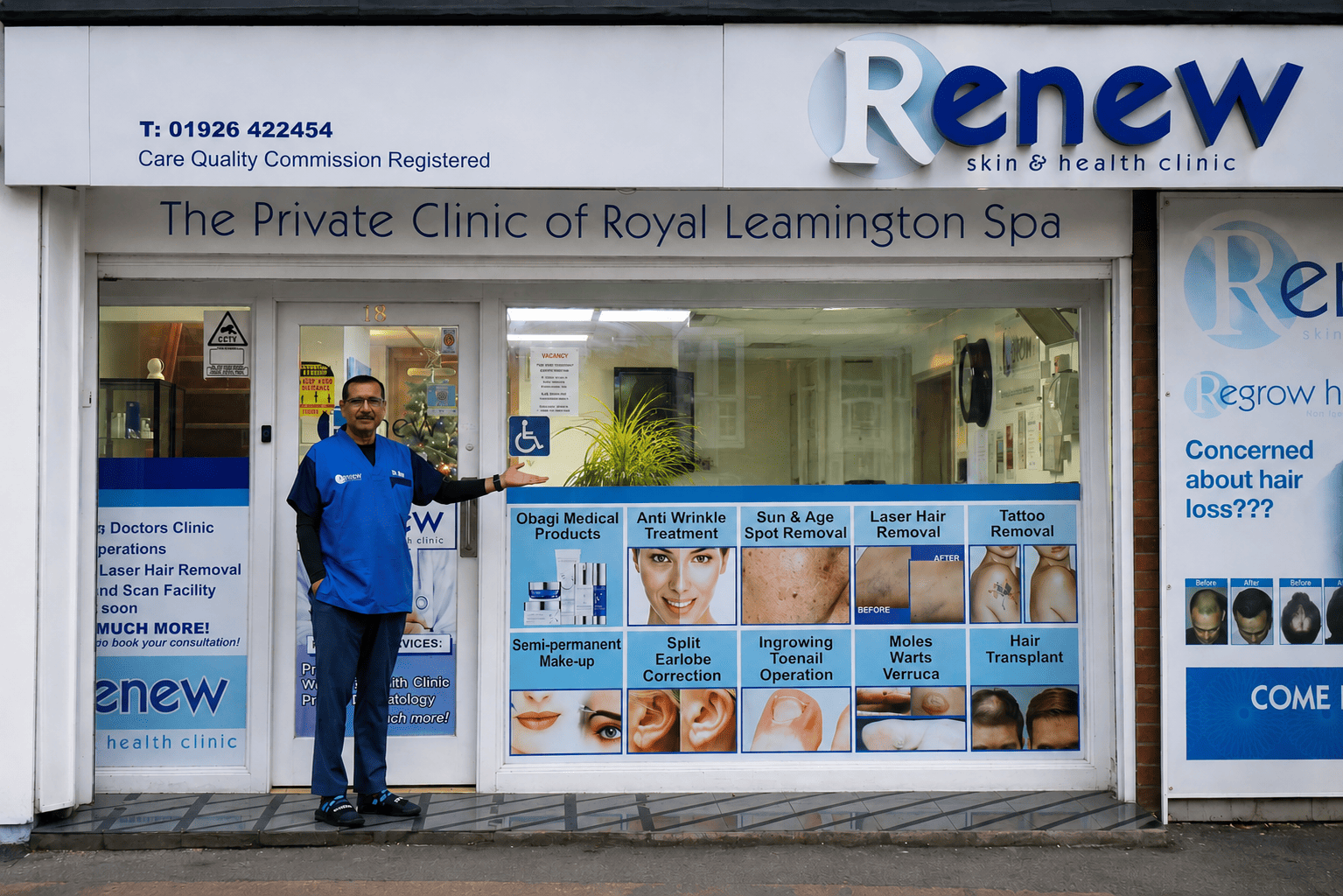
Why Choose Renew Skin & Health Clinic for Angiokeratoma Treatment?
Directed by Dr. Nawal Kishore Jha, Renew Skin & Health Clinic has been offering cosmetic, dermatology, and laser therapies since. Patients choose us because of:
- CQC Registered Clinic
- Certified Medical Staff with more than 30 years of combined medical experience
- Same Day Appointments
24/7 Doctor Aftercare - Consultant delivered procedures using modern laser platforms.
- Price transparency, clear and transparent with no hidden fees
- Access is easy via Coventry, Warwick, Kenilworth, Rugby, Stratford upon Avon, Banbury, Northampton, Solihull and Birmingham.
Every angiokeratoma patient is handled with total discretion, with particular attention given to patients seeking treatment for genital lesions, who naturally want a calm and non judgmental environment.
Request a call back
Book Your Angiokeratoma Consultation Today
If you’re worried about bleeding, angiokeratoma, pain, or appearance of a lesion, our experts at Renew Skin & Health Clinic can assist you by providing safe, discreet and effective treatment.
- Call:+44 1926 422 454
- Email:
- Address: 18 Guy Street, Leamington Spa, CV32 4RT, United Kingdom
- Whatsapp: +44 1926 422 454
Frequently Asked Questions
1. What does an angiokeratoma look like before treatment?
Angiokeratoma, prior to treatment, typically is seen as dome shaped, small lumps that range in color from bright red to black or purple and sometimes have a rough or scaly surface, particularly in lesions that are more established.
2. What can I expect to see in angiokeratoma before and after photos?
Most patients see the treated lesion appear noticeably flatter and lighter in colour within a few weeks of healing, with the surrounding skin remaining largely unaffected by the laser.
3. What number of laser sessions is required to see visible angiokeratoma results?
Most patients can achieve great results from a single session. More extensive lesions, or clusters of them, might require a second session dependent on their size and depth.
4. Is angiokeratoma laser therapy painful?
Most patients report only some mild heat or sensation of stinging during treatment, and numbing anaesthetics are also available to improve comfort.
5. How long will it take to heal after angiokeratoma treatment?
Patients can resume routine activities immediately, with full healing usually taking several days.
6. Will angiokeratoma come back after laser treatment?
Recurrence is uncommon. If new lesions do appear, they tend to be smaller and fewer in number, making retreatment straightforward.
7. Is angiokeratoma from Fordyce similar to an STI is it?
It’s not. Angiokeratoma from Fordyce isn’t transmitted sexually, is not contagious, and does not have a connection to hygiene. It is only a vascular skin condition.
8. What makes angiokeratoma different from Fordyce spots?
Angiokeratoma results from blood vessels that have widened and can rupture if they are irritated. On the other hand, Fordyce spots are non threatening sebaceous glands with pale skin that don’t bleed. A medical exam can determine the type of condition you are suffering from.
9. What does the removal of an angiokeratoma cost at Renew Skin and Health Clinic?
The treatment starts at PS695, and the cost is determined by the size and number of lesions. The appointments on weekends incur an additional fee, and 0% financing is available with an initial PS195 deposit.
10. How can I book an angiokeratoma consultation in Leamington Spa?
You can call +44 1926 422 454, WhatsApp the same number, or email info@renewskinandhealthclinic.co.uk to arrange a confidential consultation at 18 Guy Street, Leamington Spa, CV32 4RT.